Discovering New Worlds with Gravitational Waves: The LISA Mission
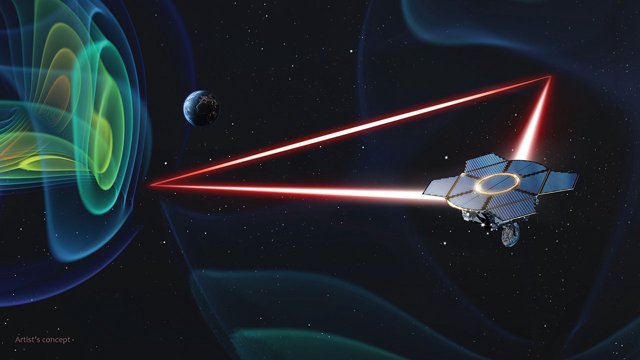
Hey there, cosmic explorers! Have you ever gazed up at the night sky and wondered what lies beyond our solar system? Well, buckle up, because NASA scientists are paving the way for some mind-blowing discoveries! Their new mission, called LISA (Laser Interferometer Space Antenna), is all set to unveil a treasure trove of exoplanets—those intriguing worlds orbiting stars outside our very own solar system.
So, what exactly are gravitational waves? Picture ripples in the fabric of space-time, caused by massive celestial bodies dancing around each other. LISA will be listening for these tiny ripples, and two recent studies have shown that it could uncover a brand-new population of exoplanets hiding in double white dwarf systems. As these white dwarfs orbit closely, if a planet is also lurking nearby, it will leave its mark on the gravitational wave signals that LISA detects. It's like cosmic graffiti that tells us about the presence of a planet!
Casey McGrath, a postdoctoral researcher involved in this exciting research, explains that the most promising sources for LISA's discoveries are double white dwarf systems. These systems are made up of two white dwarfs in tight orbits, and they've got a lot going on! When a planet orbits one of these binaries, its gravitational pull sends ripples through space-time, creating unique signals that LISA can pick up. How cool is that?
What's even more thrilling is that LISA isn't flying solo. The mission is set to launch in the mid-2030s and is a collaboration with the European Space Agency (ESA). NASA is contributing essential hardware, telescopes, and scientific support to help unlock the mysteries of the universe. The potential to detect exoplanets around these double white dwarf systems was first suggested back in 2008, and now it’s becoming a reality!
The excitement doesn’t stop there! With the James Webb Space Telescope also on board, scientists will be able to confirm these discoveries and learn more about the planets’ characteristics. Imagine the thrill of finding new worlds just waiting to be explored! Astronomers estimate that our Milky Way galaxy has about 10 million double white dwarf systems, and LISA could resolve around 10,000 of them, bringing us closer to understanding the cosmos in ways we’ve never imagined.
So, keep your eyes to the stars, fellow stargazers! The journey to discover new worlds is just beginning, and we might soon be uncovering the secrets of distant planets thanks to the incredible work of scientists and the revolutionary LISA mission. Who knows what amazing wonders await us out there in the universe!



💬 Comments
Log in to join the conversation.
No comments yet.