The Mystery of Dark Matter: What We Learned About Primordial Black Holes
The Universe's Dark Matter Dilemma
Hey there, fellow space enthusiasts! Today, I want to share some exciting updates from the cosmic frontier about primordial black holes and their connection to the elusive dark matter we’ve all been curious about. You might have heard that these mysterious objects, which could have formed in the early universe, were once considered potential candidates for dark matter. But recent research is shaking things up!
Primordial black holes are theorized to be the result of dense clumps of matter from the Big Bang, and some scientists believed that they could be “stupendously large,” weighing in at over 100 billion times the mass of our sun! This concept intrigued astronomers because dark matter is thought to make up about 85% of the universe, and understanding its composition is one of the biggest puzzles in astrophysics.
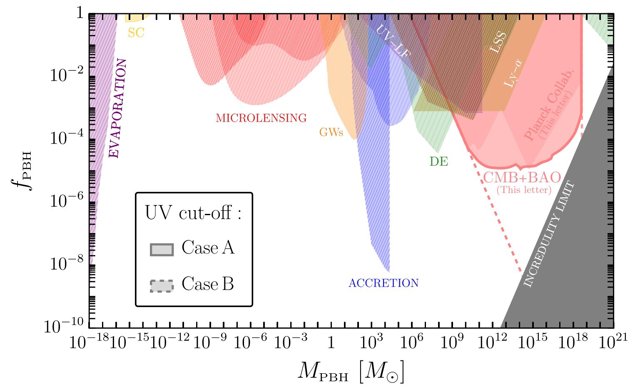
A team led by Nicholas Leister at the Mainz Institute for Theoretical Physics recently conducted research that challenges the idea of primordial black holes being significant contributors to dark matter. They approached the problem by examining how these black holes would be distributed throughout the universe. If they were scattered randomly, it could lead to varying densities of dark matter across different regions of space, potentially leaving a distinct imprint on the cosmic microwave background (CMB) radiation—the afterglow of the Big Bang.
Upon analyzing the patterns in the CMB, the researchers found that if a substantial number of these massive black holes existed, the uneven distribution would create noticeable signatures in the cosmic background radiation that we simply do not see. This means that while primordial black holes are still a possibility, they can't account for a significant portion of dark matter as we once thought.
However, don’t count primordial black holes out just yet! The study does not completely dismiss their existence, as future research could explore populations of black holes with various masses. Upcoming experiments, like LiteBIRD and the Simons Observatory, are set to refine our understanding of dark matter even further. Who knows? The secrets of the universe might be closer to unraveling than we think!
So, as we continue to gaze up at the stars and ponder the mysteries of the cosmos, let's keep our minds open to new discoveries. The universe is full of surprises, and every bit of research brings us one step closer to understanding the true nature of dark matter.



💬 Comments
Log in to join the conversation.
No comments yet.