JWST Unveils 104 Stellar Events in the Dazzling Dragon Galaxy
Exploring the Dragon Galaxy
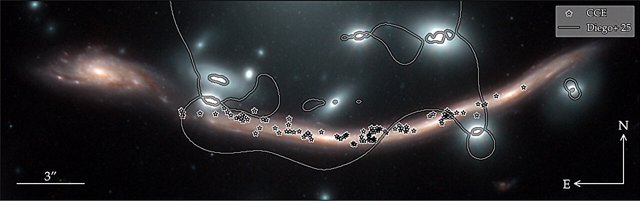
Hey, space enthusiasts! Buckle up as we embark on an exciting journey through the cosmos, courtesy of the James Webb Space Telescope (JWST). A remarkable team of astronomers has recently made a groundbreaking discovery in a galaxy known as the Dragon, located a whopping 6.5 billion light-years away! They identified an astounding 104 magnified stellar events, more than doubling the previous record of 44 detections. This discovery not only showcases the brilliance of the stars in the Dragon galaxy but also gives us valuable insights into the elusive nature of dark matter.
So, what’s going on in the Dragon galaxy? The light from this galaxy is stretched and magnified by a massive galaxy cluster named Abell 370. This phenomenon is known as gravitational lensing, and it’s the reason the galaxy appears as a beautiful arc—aptly called the Dragon arc. But here’s the twist: the gravitational lensing effect isn’t uniform. Some regions experience stronger magnification than others, leading to a dazzling display of celestial events.
When astronomers observe these events, they’re not just watching any stars; they’re catching sight of some of the most luminous supergiants, which come in two flavors: blue and red. Blue supergiants are hot and emit light at shorter wavelengths, while red supergiants are cooler and shine in the near-infrared. The balance between these two types of stars can tell us a lot about the stellar population in the Dragon galaxy—whether it’s a young, star-forming region or an older one filled with more mature stars.
To uncover these stellar secrets, the research team, led by José María Palencia, meticulously analyzed images taken by JWST from 2022 to 2024. By comparing images of the same region taken at different times, they tracked changes in brightness caused by what are known as caustic crossing events (CCEs). These brief moments occur when the light from a star gets focused so intensely that it can shine hundreds or thousands of times brighter than usual, only to fade back to normal within days or weeks.
This new catalog of 104 unique CCEs represents the largest sample of highly magnified star candidates identified in a single galaxy to date! It’s thrilling to think about what these discoveries can reveal about the Dragon galaxy’s history and its relationship with dark matter. As we continue to explore the universe, who knows what other cosmic wonders await us? Keep your eyes on the skies, fellow stargazers!


💬 Comments
Log in to join the conversation.
No comments yet.