Unveiling the Mystery of Black Holes from Failed Supernovae
Stars That Fade Away: The Curious Case of Black Holes
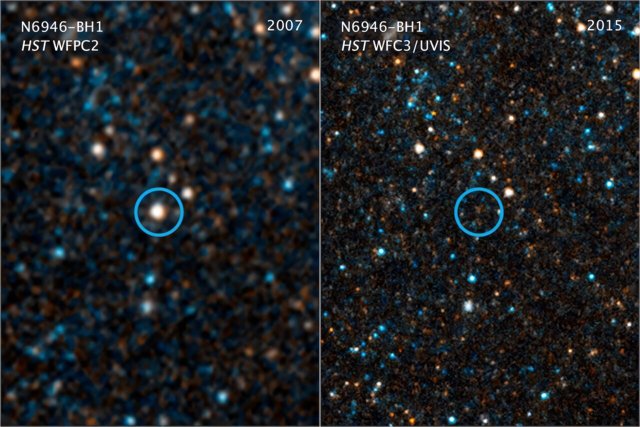
Hey there, fellow space enthusiasts! Today, I want to dive into a fascinating new study that sheds light on one of the most enigmatic phenomena in the universe: black holes. Traditionally, we think of massive stars exploding in brilliant supernovae, hurling their outer layers into the cosmos, while their cores collapse to form neutron stars or black holes. But what if I told you that some massive stars might skip the dramatic show altogether?
Researchers from Caltech have recently found intriguing hints that suggest a unique group of black holes may have formed from what are known as "failed supernovae." Instead of exploding, these massive stars may have simply collapsed inward, leading to the creation of black holes without the spectacular fireworks we usually associate with stellar death. While the study didn’t provide direct evidence of these failed explosions, it drew connections between gravitational-wave data and theoretical predictions, which is super exciting!
The Laser Interferometer Gravitational-wave Observatory (LIGO) has been instrumental in our understanding of these cosmic events since it first detected gravitational waves in 2015. Over the years, the LIGO-Virgo-KAGRA network has identified more than 300 black hole mergers, revealing that most of them are around ten times the mass of our sun. According to Katerina Chatziioannou, a professor at Caltech, these findings suggest that the merging black holes might belong to a specific group originating from failed supernovae.
In this study, scientists examined the masses of 257 black hole mergers detected over the past decade. They discovered a striking peak at ten solar masses, suggesting that this could be a common formation pathway for black holes. Interestingly, they also noted a scarcity of black holes in the 12 to 16 solar mass range, leading to the question: why are there so few in that category? This gap could indicate that unique internal physics is at play when these black holes come into existence.
Additionally, by analyzing the spin rates of these black holes, researchers found that the ten-solar-mass black holes exhibited a narrower range of spin compared to the broader black hole population. This supports the idea that these specific black holes may share a common origin, possibly linked to that mysterious process of collapsing without a supernova.
So, what does all this mean for our understanding of the universe? It opens a new chapter in black hole research and prompts us to think differently about the lifecycle of massive stars. As we continue to explore these cosmic wonders, who knows what other secrets the universe may reveal? Keep looking up at the stars, my friends!



💬 Comments
Log in to join the conversation.
No comments yet.