A Cosmic Mystery: The Oldest Quasar Pair Discovered
Unveiling the Secrets of the Early Universe
Hey fellow space enthusiasts! Today, I’m super excited to share a fascinating discovery that has left astronomers scratching their heads. Scientists have recently found the earliest known pair of compact quasars, named Nāpōwawāʻenakaulua, which existed only 900 million years after the Big Bang. This discovery is not just another feather in the cap for cosmic exploration; it’s a puzzle that challenges our understanding of how black holes can grow to such monstrous sizes in the early universe.
Quasars are some of the most luminous objects in the universe, formed when supermassive black holes consume surrounding gas and stars, causing them to shine brighter than entire galaxies! Nāpōwawāʻenakaulua consists of two quasars that are incredibly close to each other—only about 18,100 light-years apart. To put that in perspective, that’s roughly one-fifth of the diameter of our own Milky Way galaxy! The mass of these black holes is staggering as well, weighing in at 1.5 billion and 400 million times that of our Sun. That’s a whole lot of space gravity!
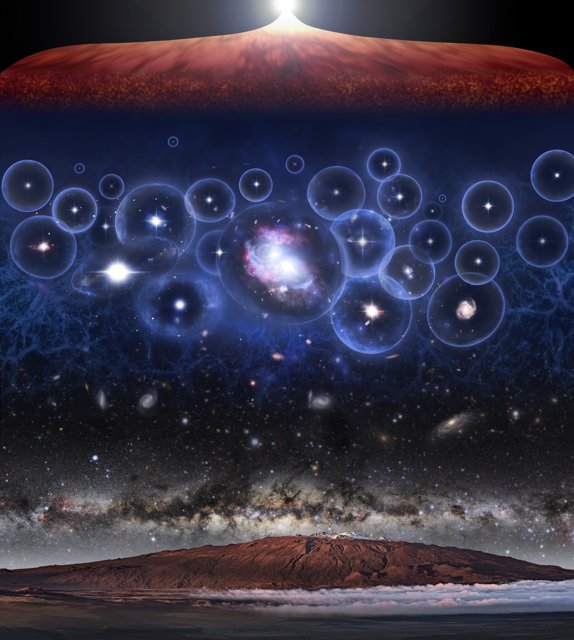
Discovered using the Gemini North telescope on Maunakea, Hawaii, along with the advanced James Webb Space Telescope, this pair is not only remarkable for its age but also for its compact nature. While astronomers expected to find quasar pairs from the early universe, actually locating one has proven to be quite challenging due to the faintness of these distant objects and the short-lived nature of their quasar phase. The existence of Nāpōwawāʻenakaulua so early in cosmic time is a stirring reminder of the mysteries that still linger in our universe.
What’s particularly mind-blowing is that scientists don't have a solid explanation for how such massive black holes could have formed so quickly. The first billion years after the Big Bang were a chaotic time, with galaxies merging and dark matter halos collapsing, but the rapid growth of these quasars is still a cosmic conundrum. The discovery raises questions about the mechanisms of black hole formation and the nature of the universe itself. Could there be processes at play that we haven’t yet uncovered?
The name Nāpōwawāʻenakaulua beautifully encapsulates its essence, translating to "Two celestial bodies of fathomless powerful darkness in the brilliance of heat reincarnating energy into the universe." This name serves as a poetic reminder of the profound mysteries waiting to be unraveled in the cosmos. As we continue to push the boundaries of our understanding, I can’t help but feel excited about what future discoveries await us in our quest to explore the universe!




💬 Comments
Log in to join the conversation.
No comments yet.