Hubble's Gravitational Lenses Set Stage for Roman Telescope Discoveries
Exploring Cosmic Lenses: A Journey with Hubble and Beyond
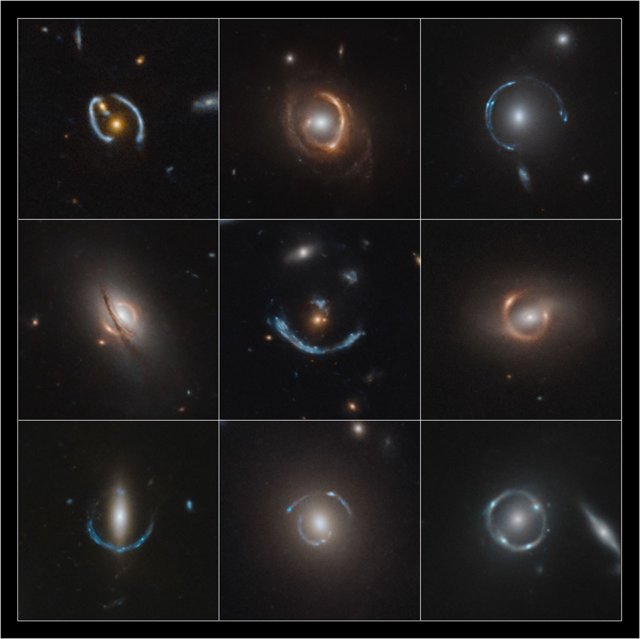
Hey space enthusiasts! Did you know that the universe has a way of bending light? No, I’m not talking about a funky light show at a rave; I’m referring to the fascinating phenomenon of gravitational lensing, a cosmic trick that helps astronomers see distant galaxies in ways they could only dream of. Thanks to the incredible work of NASA's Hubble Space Telescope, we now have a stunning gallery of these gravitational lenses, which will aid the upcoming Nancy Grace Roman Space Telescope in its mission to unravel the mysteries of our universe.
Gravitational lensing occurs when a massive foreground object, like a galaxy cluster, warps the light from a background galaxy. Imagine looking through a giant cosmic magnifying glass! This effect allows us to observe galaxies that are much farther away than we could with a regular telescope. Hubble’s newest images highlight a variety of lensing scenarios, from duplicated arcs to the breathtaking Einstein ring, where a galaxy is perfectly aligned with the foreground mass, creating a beautiful halo of light.
But why is this important? Well, by studying these cosmic lenses, astronomers can gather crucial information about the mass of galaxies, including the elusive dark matter that makes up a significant part of our universe. The amount of distortion in the light from these lensed galaxies can tell scientists about the mass distribution in the foreground galaxy, including those hidden clumps of dark matter that we can’t see directly. Hubble will provide high-resolution images to help researchers identify these tiny imperfections, while Roman will cast a wider net to catch even more of these cosmic wonders.
The collaboration between Hubble and Roman is a cosmic dream team! Hubble excels at zooming in on individual lenses, while Roman’s broader field of view allows it to capture a vast array of lenses at once. If Roman spots a particularly interesting lens, Hubble can swoop in with its detailed observations to uncover even more secrets. It's a perfect combination of strengths!
As we prepare for the exciting discoveries that await us with the Roman Space Telescope, let’s keep our eyes to the skies. The universe is full of surprises, and with the help of these amazing telescopes, we’re bound to uncover more about dark matter and our cosmic neighborhood. So grab your telescope or find a nice spot to stargaze, and let’s get ready to explore the universe together!





💬 Comments
Log in to join the conversation.
No comments yet.